The Conversation
What Women Want

Watching a Paromita Vohra film brings small, significant discoveries that can shake us out of comfortable assumptions.
In my childhood, the word "documentary" was applied to those grainy, black-and-white short films shown before the main feature in cinema theatres — either as newsreels rounding up events, or careful narrations of some burning issue, profiles of famous people, and similar material. Even when we later saw genuinely valuable footage of icons like Begum Akhtar or Bhimsen Joshi on Doordarshan, it never quite acquired the stature of narrative mainstream cinema. By the 80s, ad films had begun bringing their makers and models money and recognition. In comparison, the short film portraying reality was shrinking — reduced to a vehicle for family planning messaging, or confined to a smaller and smaller audience.
It was only in my early 40s that I began to seek out and watch documentaries for their own sake, and Paromita Vohra's films were an important part of that shift. I was living in Chennai then, but my life was about to be shaped by events in Mumbai in ways I didn't realize at the time. The Mumbai International Film Festival, or MIFF — long the prime biennial event for showcasing documentary film — ran into rough weather in 2004, when films critical of communal identity politics, or films that spoke of the human rights of marginalized communities, were rejected for screening through a policy of covert censorship. In response, 275 documentary filmmakers came together to create their own alternative platform, Vikalp, for public screenings. Not only did Vikalp screen the films that had been excluded from MIFF that year, but many filmmakers whose work had actually been selected withdrew it in solidarity, to screen at Vikalp instead. It has remained a forum for independent screenings ever since, and Bangalore has its own Vikalp chapter.
I saw the 2004 Vikalp films in Chennai, when Ranvir Shah's Prakriti Foundation began its One Billion Eyes film festival, screening dozens of documentaries every year. That's how films like Rakesh Sharma's Final Solution, Sanjay Kak's Words on Water, Anand Patwardhan's Ram ke Naam, and Bishakha Datta's In the Flesh reached us — before distribution became easier through the internet. From then on, I was hooked on non-fiction cinema in a way that had been denied to me earlier.
Even among the many well-researched, starkly presented films of that time, Paromita Vohra's Unlimited Girls and Q2P stood out for me. Beyond the fact that their content was easier for me to identify with, being a woman myself, they brought quirky, unusual insights into everyday living. Before I ever met or saw Paromita, she was, to me, a confident, jaunty chronicler whose frames pulsated with life. Her subjects spoke direct and unfiltered into her camera or among themselves; her graphics, mixing colour and kitsch, tied the narrative together; her voiceover gave the visuals added weight without ever turning preachy. I became a proud Paromita Vohra fan and follower two decades ago.
Which is why, when Vikalp Bangalore screened her film Working Girls (2025) at the Bangalore International Centre on the 19th, there was no way I was going to miss it.
Working Girls was made in collaboration with the Laws of Social Reproduction project at King's College London, a research initiative examining the legal systems that regulate women's reproductive and care labour across India. As viewers, we're pulled willy-nilly into the world of erotic dancers and sex workers, domestic workers and care providers, egg donors and commercial surrogacy agents. Across all these different locations and layers of occupation, one question haunts the women working in Madurai or Pune, Thiruvananthapuram or Latur: how does the work we do get recognized as work, and get its full value?
Vohra brings us close to Kausalya, an ageing Karagattam dancer whose existence has been made precarious not just by changing times and a public preference for younger aadal-paadal dancers, but by rejection from her own family. She takes us into the kitchen of Vanitha Mane, a sex worker in Pune's Budhwar Peth, urged by her partner Arjun to fry some fish for breakfast. She lingers with a woman in Latur who works the fields, cooks two meals, runs a provision shop for a few hours, and does tailoring — all in a single day, all to support her family. We meet ASHA workers who have been the primary health caregivers for entire communities, for Rs. 232 a day, year after year — who worked through the pandemic in 2020-21 for a Rs. 500 bonus.
When the film wanders through the claustrophobic slum lanes that Rita Ghosh, a former surrogate mother now working as an egg donor agent, has managed to leave behind for a flat where she lives with her family, we're brought face to face with how surrogacy grew in India — and how it has since been nearly stymied by laws asserting government control over individual agency.
Humour and wit have always been a noted part of Paromita's films, though it isn't always deliberate on her part. She does make us laugh aloud at the absurdity of government acronyms, or draw a sarcastic chuckle at the antics of self-appointed guardians of "culture" and morals. But often it's simply a stray comment from one of her subjects, or a matter of timing, that gets the laugh. Asked her name, the striking ASHA worker laughs and replies, "Asha."
More than bringing humour to difficult subjects, what her films do best is make us question much of what we've been led to believe. Why are all sex workers seen as victims? Why is it so hard to imagine young, fit women wanting to be erotic dancers? Why is it acceptable for management professionals to talk of "monetizing" every jot of their effort, while domestic workers and ASHA workers are expected to offer their care for peanuts? Work, it becomes clear, is ceaseless for most women. And so much of it is expected to be free.
The hardest moment in the film comes when a young domestic worker in Meghalaya, Alma, describes how an employer had been transferring a mere Rs. 500 a month into a recurring deposit as her salary for a ton of housework — something she didn't discover until much later. As her eyes fill with tears, one recoils at such meanness, and another question surfaces: how do employers like this continue to be considered "respectable" in our society, while domestic work is considered less worthy of respect?
The solidarity working women show one another — through the Saheli Sangha of Pune, the Kerala Asha Health Workers Association (KAHWA), the Meghalaya Domestic Workers' Union, or the Durbar Mahila Samanwaya Committee in Kolkata — brings a strong thread of hope and relief to the film. And yet, the sight of thousands of women lining up to apply for police constable jobs in Mumbai brings back a familiar ache that millions of women must carry each night: when will I be doing work that is valued, that lets me be independent?
Comments
explore more
The Conversation

The Mundane as Miracle
When one has been denied of so many things that brought joy in the past, there is still comfort to be had, and it comes from an unexpected direction...
The Conversation

Resist, Reboot, Reset, While You Still Can
Every so often, an opportunity arrives, for us to take ourselves less seriously, laugh out loud, and yes, look a little more seriously at what our life is all about…
The Conversation

The Importance of Being Gen Alpha
What are school students talking and thinking about? I was given the chance to find out some of their ideas and concerns
The Conversation
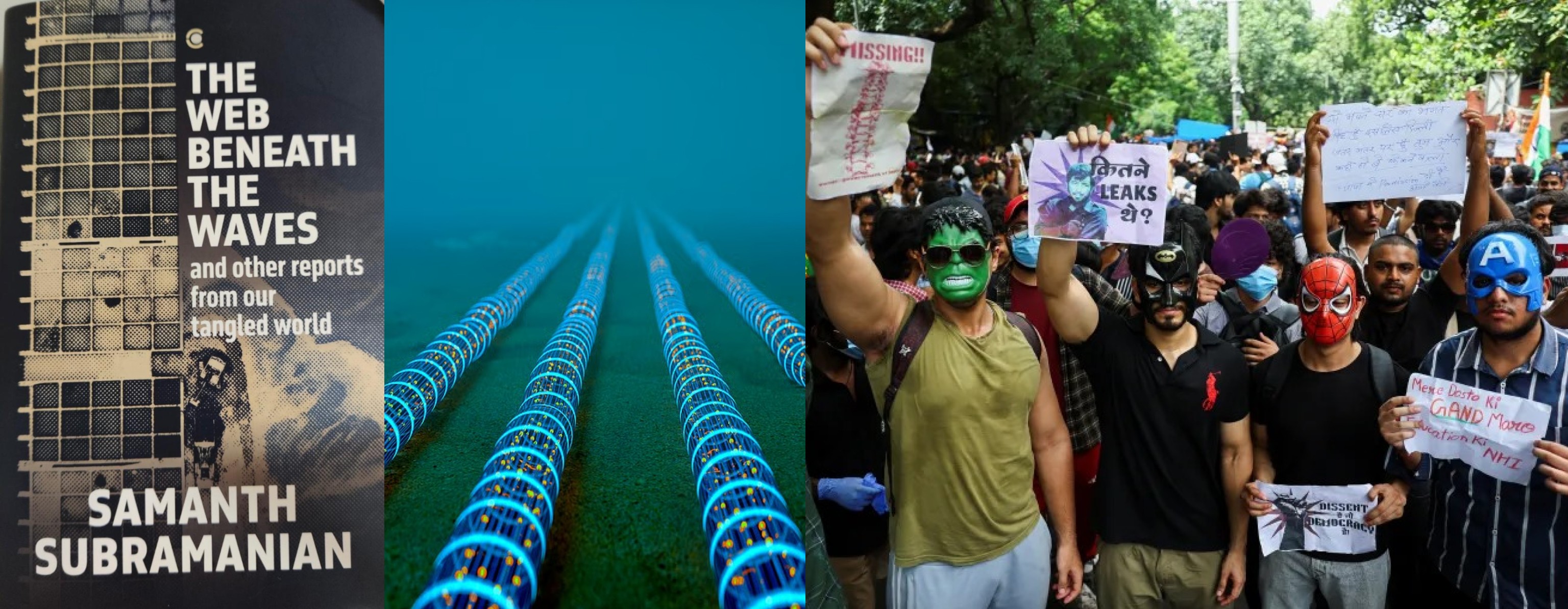
Interconnectedness and the Internet
The world wide web has drawn us closer, if we are to go by recent experience. Yet, fearmongers are already giving a ‘nationalist’ hue to certain debates.
The Conversation

Big Screen Reunion
A long hiatus ended with a fresh new film in theatres, giving me the opportunity to indulge once again.
The Conversation
What Women Want
Hint: Money, Value, Autonomy…