The Conversation
Interconnectedness and the Internet
So many spiritual traditions have emphasized the interconnectedness of life that it is difficult to list them all. Whether it is the idea of the universe as a single, conscious whole, and individual souls representing the continuous flow of life within this, or the idea that all of creation is a single, living tapestry reflecting God, philosophers and mystics across the world have presented all existence as one. In fact, not only is this worldview common to traditions that arose in different parts of the globe, it is also supported by another idea amongst most of them – that the perception of separateness is an illusion. From the Hindus to the Sufis, Buddhists to Native American mystics, all have decried the ego-driven maya, kasrah or avidya that prevents us from understanding the unity of all existence.
For of course, it is out of the illusion of separateness that we can think of harming or hurting another without being affected by it in the least. Looking around us at the bombs and missiles raining down a few thousand kilometres away, the greed and corruption in our own midst, with the devastation they cause daily, it is not hard to understand how maya and avidya seem to have the upper hand everywhere.
Yet, as the ego-driven illusion of separateness becomes more powerful, we, the human race, have also become connected in a manner that had perhaps not been imagined by our ancestors. We can connect in milliseconds, by our thoughts, queries, discoveries and comments with people who may be on the other side of the earth, all because of the instantaneous information exchange that we call the internet.
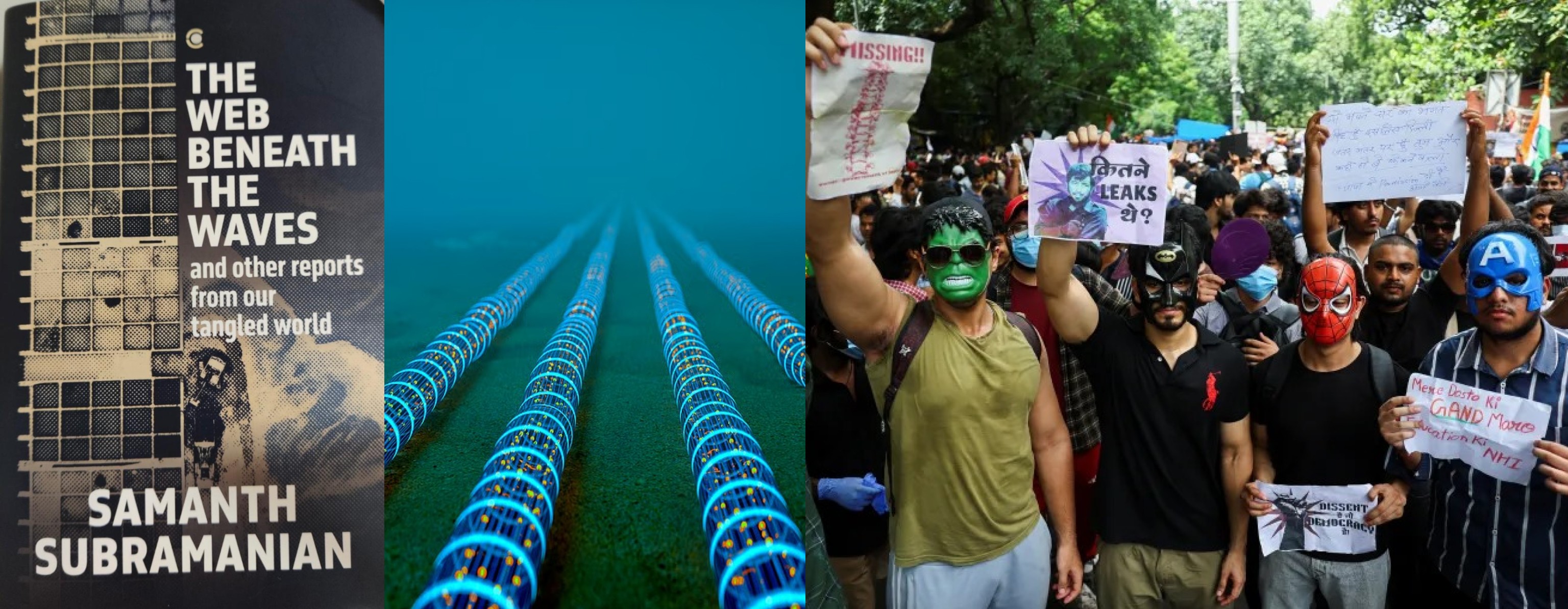
I was made to reflect on the ubiquity and everyday miracle of the internet by the work of Samanth Subramanian, who was a fellow Chennai resident in years past, and has distinguished himself for meticulously researched prose that makes for racy and rewarding reading. In Bangalore recently, Samanth spoke about his work one evening at the Bangalore International Centre in a panel discussion with Sharda Ugra and Aakar Patel. That’s where I picked up his collection of essays, The Web Beneath The Waves and other reports from our tangled world (Context 2026).
Samanth, who has been published in Granta, The Guardian, the New Yorker and New York Times, has always possessed a curiosity that has stood him well in an era where the mind can wander in a myriad rabbit holes, all aglow with jewels of information. He can make one want to know more about the Jews of Nigeria, the evolution of a rich young Sri Lankan into a suicide bomber, the well-heeled members of the Breach Candy Club or the fight between Dyson, makers of the Airblade used in public restrooms, and a phalanx of paper towel companies. This is because he writes with the insights and observations of those he has interviewed, and the detailing that goes with his self-confessed character as a quiz obsessive.
“In the abysmal depths of the ocean, a data cable is a scrawny, lightly clothed thing. Its core consists of fibres of glass, each no thicker than a human hair, through which light transmits information at roughly 125,000 miles per second. Around the fibres, there is first a casing of steel for protection, then another of copper to carry electricity to keep the light moving, and then a final sheath of nylon soaked in tar. All this swaddling may sound like plenty of protection, but the layers are all thin, and the final product is – to use the image I heard most often from people in the subsea cable industry – no fatter than a garden hose.”
The Web Beneath Our Waves essay begins as an investigation after Tonga, the archipelago nation of the Southern Pacific lost internet in January 2022 after an undersea volcano erupted. It goes on to give an inside glimpse into how undersea cables are planned and laid, and the people who put them in place. Of course, it also speaks about the control of the cables and the information cruising through them – bringing up the expected names of Google, Microsoft, Meta and Amazon.
The ethics of who is capturing our data, and how it is being used, what we are being shown through the internet, and what is being hidden from us, have become hot topics of study and debate in the past decade. If The Social Dilemma (2020) brought us face to face with the manipulative nature of social media algorithms, Coded Bias (2020) showed us the severe racial and gender stereotype biases built into facial recognition systems. Cables have also become an important element in geopolitics with the threats that have been made by IRGC to cut the undersea cables of the Big 4 if the US and Israel escalate matters further in their unjust and irrational war. As time goes on, we have to become extremely vigilant about what is streaming through those undersea cables, and how it is being used to build a better world…or worse.
However, there is a danger that some forms of vigilantism can end up feeding the propaganda factories. The recent concerns expressed by an academic about how “foreign” algorithms are engaging in “cognitive warfare” and inciting Indian youth towards violence and vulgarity have to be seen in this context.
If anything, the recent demonstrations and solidarity among Indian youth and children is showing us an explosion of joy and creativity enabled by reach of the internet. Our youth have been non-violent in the manner of their freedom fighter ancestors, have directed profanity towards those who have wielded it the most, and have turned the tables on the use of Meta/WhatsApp/Facebook by hate factories to the use of Meta/Instagram to promote solidarity across class, caste, gender and religion.
Yes, we do have to stay cautious and careful about how the internet and AI shape our future. But if the values of our own young people are anything to go by, the internet has today served to underline the interconnectedness of life, not the separateness peddled as wisdom by some.
Comments
explore more
The Conversation

The Mundane as Miracle
When one has been denied of so many things that brought joy in the past, there is still comfort to be had, and it comes from an unexpected direction...
The Conversation

Resist, Reboot, Reset, While You Still Can
Every so often, an opportunity arrives, for us to take ourselves less seriously, laugh out loud, and yes, look a little more seriously at what our life is all about…
The Conversation

The Importance of Being Gen Alpha
What are school students talking and thinking about? I was given the chance to find out some of their ideas and concerns
The Conversation
Interconnectedness and the Internet
The world wide web has drawn us closer, if we are to go by recent experience. Yet, fearmongers are already giving a ‘nationalist’ hue to certain debates.
The Conversation

Big Screen Reunion
A long hiatus ended with a fresh new film in theatres, giving me the opportunity to indulge once again.
The Conversation

What Women Want
Hint: Money, Value, Autonomy…
Comments