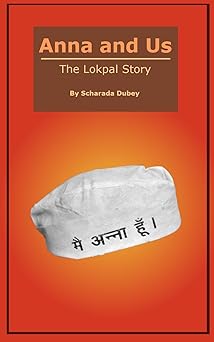
Anna and Us: The Lokpal Story
Politics
An account of the India Against Corruption movement of 2011-2012, and what it meant for society and politics in the following years.

Overview
The churn in civil society in the years of the UPA 2 government had coalesced around the discourse of corruption and the need for the office of the Lokpal to address corruption by public servants. The figure of Anna Hazare, veteran social activist whose organization had greened a dry region in Maharashtra became a symbol around whom Arvind Kejriwal, and what later became the Aam Aadmi Party, attracted a large following. This book examines the tumultuous course of 2011-12, at Lucknow, in Ralegan Siddhi, on social media and the streets of major cities. Written from close observation and personal experience, it contains insights that can give one pause to think, as well as reason to chuckle!

A Glimpse Inside
Chapter 5: A Lokpal By Any Other Name
Anna: We want a strong Lokpal Bill. Ours. | Cong: Agreed. We want a strong Lokpal Bill. Ours. | BJP: Yes. We want a strong Lokpal Bill. Ours
By the time 2011 ended, Indians literally had ‘Lokpal’ coming out of their ears.
After nine months of campaigning for the Lokpal Bill, it was passed in the Lok Sabha on the 27th of December, 2011. Alas, the pregnancy could not be considered to have resulted in a satisfactory birth, because the bill failed to make it through the Rajya Sabha on the 29th of December, 2011, and a copy of it was actually torn inside the Upper House during the raging debate over the Bill.
But what was the import of the torn Bill, and should citizens have been rejoicing because a ‘bad, bad, Bill’ was being defeated in Parliament, as alleged by Team Anna, or should they have been mourning the defeat of a piece of legislation largely driven by citizens’ concerns at the hands of a political class united in its complicity? Rank confusion prevailed, complicated not the least by the fact that Anna Hazare had begun yet another indefinite fast on the 27th of December, 2011, this time at the MMRDA grounds in Bandra-Kurla Mumbai.
For months, the discussions on the Bill that were seen and heard on television went back and forth around a) the inclusion of the Prime Minister under the ambit of the Lokpal b) the inclusion of the lower bureaucracy under the Lokpal, since these were the officials most likely to impact the ‘aam aadmi’ in his attempt to get the system to deliver anything from a driving license, birth or death certificate, property related papers etc. etc. c) the investigative agency that would be assigned to the Lokpal and whether or not the CBI was to be that agency. In the first debate on the Lokpal Bill in August 2011, Rahul Gandhi added another dimension to the issues around the existence and shape of the Lokpal, by strongly urging for it to have a Constitutional status on par with the Election Commission.
For the man on the street, even one who was not in the habit of reading the editorial page on a daily basis, the miles of newsprint and weeks of TV time spent on the Lokpal brought home some important truths about our country and democracy.
Corruption had finally reached center stage in matters of urgency and importance facing the nation.
Politicians who had wielded the power to control unlimited resources, were now being called to account for the criminal misuse of such resources.
For the first time in more than 20 years, citizens were being asked to give voice to any demand concerning their own welfare and democratic rights.
This marked a huge change from the way democracy has been practiced in the country, wherein it was always about elections, and the issues that political parties chose to raise against each other, in order to woo different sections of the electorate. By speaking about their rights between general elections, citizens were getting to test the frontiers of their own democracy.
Because a law was sought to be made by riding on popular sentiment, citizens were confused and apprehensive about whether the law would indeed come about, and whether this would mean a failure or success for them. Different sections of society, had their apprehensions about the relative benefits they would enjoy. The various versions of the Lokpal – from the Jan Lokpal put forward by the civil society representatives on the Joint Drafting Committee, the Government Lokpal versions of August and December 2011, the various inputs received by the Parliament Standing Committee, including drafts from NCPRI, Jayaprakash Narayan and Dr. Udit Raj were not explained or compared in any detail except for the small tabular comparisons put out by the leading newspapers or TV channels during panel discussions. This caused people to be hazy about the law, but passionate about having it passed (or not).
All the time that could have been spent on educating citizens, making them more aware of their own responsibilities and role, and the way the Lokpal Bill would impact the lives of each and every one of them, was spent in trading charges and counter charges between pro and anti-government spokesmen in the media.
The media treated the anti-corruption campaign like manna from heaven, first uncritically covering events as they occurred, and in the later months, keeping up a saturation coverage of endless ‘discussions’ on various aspects of the Lokpal Bill, the strategies of the government or Team Anna. Very few nuggets of actual information or even, the semblance of reasoned argument could pass these panel groupings. For the most part, they remained political slugfests between the usual suspects – the Congress and the BJP, or the government and Team Anna. As participants shouted at each other, channels usually kept the camera on both, with a divide on screen, actually presenting these ill-mannered displays as prime time offerings.
The government, the UPA 2 alliance led by the Congress party, did not cover themselves with glory in how they handled the demand for the Jan Lokpal and how they treated the leading figures of its campaign. There was particular disaffection among the public for the ‘dirty tricks’ department of the congress personified by Shri Digvijaya Singh.
The members of Team Anna, who had begun their campaign occupying the high moral ground of activists and individuals of high personal integrity, were exposed to be ‘only human’ in some instances, leading to a loss of some of their credibility. Their negotiating skills, unity and cohesiveness, and ability to communicate with their followers were also found wanting at crucial points of the struggle.
All the fault lines of our society and polity – the politics of quota and the struggle for social justice, secular versus communal contradictions, the different roles of state and central governments in the federal structure – all these came up to influence the Lokpal debate at its most crucial juncture, among the country’s elected representatives.
Was it any wonder then, that the whole period of April to December 2011 should have concluded leaving many of us wondering about a whole lot of issues, some of which were:
How did this whole Lokpal business start? How did civil society come to be in such a ferment about drafting a law?
Whose draft was the first, the best, and who were the rest?
How do the powers of parliament and the rights of citizens find common ground in a healthy democracy? Are the rights of citizens to be surrendered to make Parliament more powerful, or vice versa?
Have we seen the end of a short-lived attempt to intervene in the manner in which our country is governed, particularly in the manner in which people are able to redress the issue of non-delivery of goods and services due to corruption?
Selected passage from the book