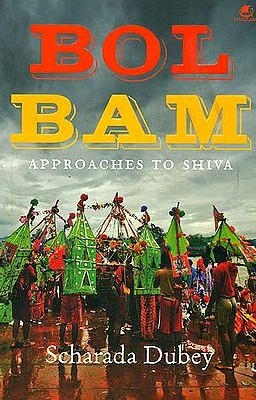
Bol Bam: Approaches to Shiva
Spirituality
A book that undertakes a ‘yatra’ to many Shiva shrines around the country, in the company of all manner of pilgrims.

Overview
Life in the present challenges belief in many ways. If I continue to believe in a God, what is it that I believe in? What solace do the poor and marginalized find in God, and does it empower them to address injustice and inequality? What is the nature of Shiva worship, among all the gods of the Hindu pantheon, and how did it unfold, in my life as a believer? This book is as much an examination of my own faith, as it is of what I have observed of the faith of thousands whom I encountered, from Kedarnath to Thiruvannamalai, Varanasi to Somnath and many other places in India.

A Glimpse Inside
Introduction: The Problem of Faith
Our names reveal the faith our parents and forefathers practiced, and it is their actions that lay the foundation for how we will approach it in our own lives. Of course, the first appearance of faith in our adult selves is in a form of branding, as one of the ingredients of our identity. ‘Hindu, Muslim, Sikh, Isai’ we often intone in our patriotic songs, naming the four dominant religions practiced in India, and our names offer a clue as to which particular faith can claim us as one of its own, or that we can claim to represent as being significant for us. But beyond this superficial branding, whether we do indeed follow in the footsteps or dictums of a particular faith depends a lot on the way our parents approached matters at home. Which is not to say that it’s a simple equation of temple-going parents producing pious children. In fact, visible symbols of religiosity in some families lead to children growing up with a reaction to the whole question of religion. After all, if a man spends many hours doing puja, or is a pillar in his congregation at church, but gets drunk and beats his wife and children regularly, they can’t be expected to have the kindest view of his faith. Like many other things dependent on the dynamics of the family, faith can produce some unexpected results.
My faith as a believing Hindu is rooted almost entirely in the way my mother professed and practiced it in the years I was growing up. I lolled around the house and read Enid Blyton and P.G. Wodehouse, Georgette Heyer or the then ubiquitous Mills and Boon romances to the background sound of my mother singing verses aloud out of Tulsidas’ ‘Vinay Patrika’ or Ramcharitmanas. I raised a host of pets, from squirrels, rabbits, parrots, puppies and finally kittens and cats, with my mother making room for their accompanying dirt and clutter without invoking scriptural taboos or citing the daily puja as a reason for them to be kept at bay. She never insisted on any of her three children following any special routine of worship, but she would occasionally bring us closer to such matters by clever strategems – like one summer vacation when she made me read the Ramcharitmanas every day to ‘improve my Hindi’! At other times, the presence of God in our home was underlined in the simplest of ways – no fruit or sweets, new clothes or books, or any shining item of use, freshly bought, was put into operation without enjoying a few moments ‘Bhagwan ji ke saamne’ (In front of God), meaning they were always first placed before the few small figures of deities my mother worshipped each day. If I was forming any definite idea of God in those days, it would have been as an inoffensive, broadly loving but unobtrusive presence, which we gathered up and carted along with all the rest of our possessions to the numerous cities we lived in, for my mother to set up and pay homage to in each new place. My mother’s equation with her Bhagwanji certainly did not communicate any sense of fear to any of us, or make us, literally, God-fearing.
Any element of awe in relation to faith was derived from other sources, also within the family. My maternal grandmother, admonishing my cousin and me for helping ourselves too freely from jars of home-made goodies made especially for Diwali, or visitors, opened her eyes scarily wide and told us how Bhagwanji punished greedy children. She also painstakingly taught me my first prayer, ‘Sri Ramachandra kripalu bhajaman, harana bhava bhaya daarunam,’ (Tulsidas) and the importance of unfailingly turning all one’s worries to God at night before one slept, after one had prayed. I was encouraged thus to see God as the final authority on everything, one who could hand out a punishment or two, but one who could also be appealed to through the simple expedient of nightly prayer.
My paternal grandfather, who clicked around the house in wooden, single toed ‘khadaun’ (footwear used by orthodox Hindus) from a very early hour in the morning, was the only one who brought in any sense of rules or decorum to be followed in one’s practice of faith. It was he who insisted that I join my brother and cousins (all of them years older than me) in reading a few shlokas from the Bhagavadgita every morning – we sat in a line on four chairs lined up against the wall, dutifully bent over. I remember my wet hair still dripping water on the back of my neck, although it had, of course, been neatly combed.
Doing anything connected with God only after a bath, sitting upright, learning difficult Sanskrit letters, and adopting a pose of sheer concentration, all these were definitely instilled by my grandfather, who was addressed as ‘Bade Bhaiya’ (eldest brother) by everyone in the house, including us, his grandchildren. From his disciplined daily routine to his discussions on philosophy with student visitors studying in the college where he taught, my grandfather represented the structure and system of faith, while my grandmothers, both of them, and my mother, represented the feelings. It was subtle, but unmistakable – the conditioning that women were the primary nurturers and protectors of faith in a family – but not its ultimate authority.
Selected passage from the book