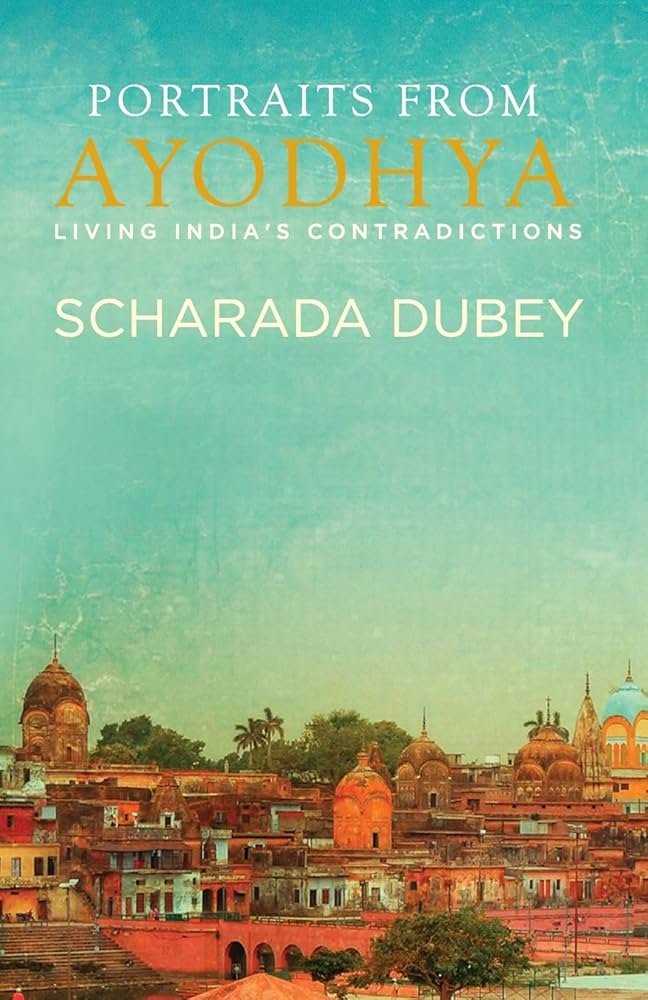
Portraits from Ayodhya: Living India’s Contradictions
Politics
A compilation of voices of 25 residents of Ayodhya two decades after the demolition of the Babri Masjid, and 13 years before the inauguration of the Ram Janmabhoomi temple.

Overview
This volume of oral history traces the lives of many distinguished and ordinary residents of Ayodhya, who recall their love for the holy town, as well as the particular difficulties that come with their being a part of the events beginning in the 1990s. In its pages, meet sadhus and mahants, astrologers and atheists, journalists and the famous litigant of the Ayodhya title suit. A book that has proved to be a rich resource for many seeking a better understanding of a town that remains in the headlines even today, Portraits from Ayodhya has acquired the status of a classic.

A Glimpse Inside
Baba Jairamdas - Ramlila’s Rakshak
Hamun sakal balakan meela, karaun sadaa Raghunayak leela.
(I will get together with all the children and forever perform the ‘lila’ of Sri Rama.)
— Hanuman’s dialogue in the Hanumat Natika by Goswami Tulsidas
Past the landmark of Mani Ram Das ki Chhavani in Ayodhya lies the neighbourhood of Vasudev Ghat. Down one of the lanes in Vasudev Ghat is the Patthar Mandir, Ayodhya’s largest and most respected training centre for Ramlila, the folk theatre performance of Sri Rama’s life. Ramlila enjoys a special status just before Dussehra, when it is performed in Varanasi and Delhi, and hundreds of small towns all across North India. In Ayodhya, a daily performance sponsored by the Department of Culture of the Uttar Pradesh government is running in its seventh year, giving the opportunity to Ramlila troupes from Mathura and Brindavan, Madhya Pradesh, Bihar, Rajasthan, and even Orissa and Karnataka to present their art before an avid daily audience of at least three hundred people. Enter the courtyard of the Patthar Mandir and you find dhoti- clad boys with long tilaks on their foreheads exercising, washing clothes, sitting or talking. These are the actors of the Ramlila, under the care and guardianship of the vyas (director and main narrator) of the Awadh Adarsh Ramlila Mandal, Baba Jairamdas, who is also the mahant of the Patthar Mandir.
Baba Jairamdas is always a pleasure to meet because he offers the affection and warm curiosity of someone used to dealing with people, and getting the best out of them. He always sprinkles his remarks liberally with a ‘behna’ or a ‘beti’, and while such consistent humility can be considered a kind of form for a sadhu, it does not fail to touch those he meets. In his appearance, he bears an uncanny resemblance to the present head of the Rama Janmabhoomi Nyas, Mahant Nritya Gopal Das, a formidably powerful sadhu and mahant of the Mani Ram Das ki Chhavani. Together, the two can easily make for a ‘separated at birth’ captioned photo. But while Nritya Gopal Das has beetling brows and a forbidding expression, Baba Jairamdas has a wide smile. Where the former is surrounded by gunners, assistants and queues of visitors eager for a darshan, the latter is at ease sans gunners or visitors, meeting the tradespeople bringing provisions to the temple, or dealing with the boys training under him. The two sadhus are not related, and are very different from one another, whatever be the superficial resemblances they share. Baba Jairamdas has lived in Ayodhya all his life. It is this town – its sadhu community, and traditions of worship – that has shaped his entire being.
Baba Jairamdas’ father, Ram Sharan Pande, was a poor Brahmin who lived with his wife and three sons in the Sri Haridwari bazaar area around Hanuman Garhi. Ram Sharan and Devaki Devi’s eldest son was born on 2 November 1940, and named Jagdish Prasad Pande. Subsequently, two more boys were born, and the last one was found to be deaf and mute. The family eked out a living by the father’s twin occupations of making tulsi-malas for sale to sants, mahants, and pilgrims, and carrying notes as invitations to bhandaras. On this income, he was able to enroll his sons at a primary school at Tulsi Chaura. When Jagdish Prasad was a mere ten-year-old student of class five, his father passed away. As if this tragedy was not devastating enough for the family, a month later Jagdish Prasad’s mother died too.
In 1950, three orphans, the eldest – Jagdish – only ten years old, his brother – Ram Narayan – aged seven, and the last – Ram Kumar, whom people called gunga (mute) – aged five, were left at the mercy of the temple town of Ayodhya. ‘In the evenings khichdi was distributed at Hanuman Garhi or Mani Ram Das Chhavani. I used to go and pick up my share, which I then divided with my brothers,’ recalls Baba Jairamdas. ‘At other times, our neighbours offered us what food they could.’ Unbelievable as it may seem in today’s harsh circumstances, the three orphans actually managed to live like this for some time.
Selected passage from the book