Why Malegaon Municipal Corporation Matters
For just over a decade the word ‘Malegaon’ has invariably been followed in the popular imagination by the word ‘blasts’. Twice rocked by explosions, on 8 September 2006 and 29 September 2008, this textile-producing hub, the second largest town in Nashik district, has remained in the headlines mainly due to the long-drawn out investigation and verdicts into both the blasts. When a special court acquitted nine Muslim men in the first case declaring them innocent on 25 April, 2016, they had spent ten years of their lives being considered as ‘terrorists’, five and a half of these in jail. Their torture and incarceration is a huge jolt to our collective ideas of justice and our claims of a spotless human rights record before the UN. Another episode in the story of the Malegaon blasts was added exactly a year later, with Pragya Thakur, former ABVP activist and accused in the 2008 blasts, being granted bail by the Bombay High court on 25 April, 2017.
Elections to the Malegaon Municipal Corporation are to be held on 24 May 2017.
Relations between Hindus and Muslims are a key factor in the business done in Malegaon. While it is a Muslim majority town with 86% Muslims in the town areas and 70% in outer Malegaon, Hindus control a significant portion of the business at the two different ends of raw material supply and finished goods trading. “Malegaon has traditionally been a place where trust between people has been the overriding factor in business,” says @RURALINDIA, a Mumbai based lawyer from Malegaon. “Crores of rupees worth of cotton yarn, for instance, can be supplied on mere oral instructions, without any need of paper. Business has always been conducted smoothly between Hindus and Muslims with both enjoying the benefits of their inter-dependence.” Muslims produce nearly all of the textiles in this town, with lakhs of powerlooms producing millions of metres of cloth every day.
This ceaseless activity also gives the town a unique character that is evident to the casual visitor. At eleven pm, the narrow streets of the old town are densely packed and bustling with shoppers and buyers, bikers and pedestrians. “This town never sleeps,” says Sharif Thekedar, a young social worker and political activist. “You will find people on the streets, awake, active at all hours of the day and night. Between 4 am and 6 am, when the looms fall silent, there is a bit of a lull, but even during this period, there are people on the roads.” Clusters of men can be seen seated on plastic stools at roadside tea shops, even late at night. Ask them for directions to reach somewhere, and one will inevitably volunteer to get in your car and take you there directly! Malegaon’s populace seems short of neither time nor generosity.
“People from Malegaon have a very secular mindset,” Thekedar continues. “They don’t get into communal debate or questions. All they want is to live peacefully, and continue to do their work.” According to Thekedar, this largely defined the nature of the town until 2001 when communal riots broke out and the town shut down for nearly one and a half months. “What amazed observers was how the long period of curfew and break in economic activity did not affect Malegaon’s people at all. They just resumed their work at 100%, exactly as before, as soon as restrictions were lifted.” After that, it was inevitable that Malegaon came on the radar of the Sangh and they tried to disrupt the economy of the place, feels Thekedar. In recent times, the lack of higher education and employment opportunities in the town has led to frustration among the youth. Thekedar himself, searching for an appropriate forum that would help him tackle such issues, was inspired by the speeches of the Owaisi brothers that he saw on youtube.com. He went to Hyderabad and joined the party and is currently its second-in-command in Malegaon.
“It was not only the Sangh, but the votebank politics of Janata Party/Janata Dal’s Malegaon MLA Nihal Ahmed in the 20 years he represented Malegaon, both of which led to the disruption of the town’s harmony,” says @RURALINDIA. “Earlier the triggers used to create tension used to be – a pig’s body parts thrown into a mosque, or a cow’s or calf’s into a temple. But after the blasts in 2006, things changed.” It was as if the stakes were higher for the interested parties out to disturb Malegaon’s peace between communities.
The nine men who were unfairly imprisoned, tortured, and finally set free as being innocent are part of a narrative that shows state agencies like Maharashtra ATS, NIA and CBI all working at various times to hold Muslims responsible for destroying the peace and tranquility of Malegaon, when it was actually Hindu right-wing extremist groups like Abhinav Bharat who had hatched the conspiracy of the blasts. This narrative was exposed when Rohini Salian, the former special public prosecutor in the Malegaon blasts case went on record with an affidavit in 2015 which said that the NIA had sent her a message in 2014 (shortly after the BJP government came to power at the centre) to “go slow” in the case where the Hindu extremists were likely to be convicted. If it had not been for Hemant Karkare and his team who cracked the 2008 blasts case, things may still have been bleak for the Malegaon men picked up in 2006. One of them, Shabbir Ahmed, died when he was doing some repairs at his home when they were out on bail. The rest of them live in and around Malegaon, and attempt to pick up the pieces of the lives they lived before their arrests.
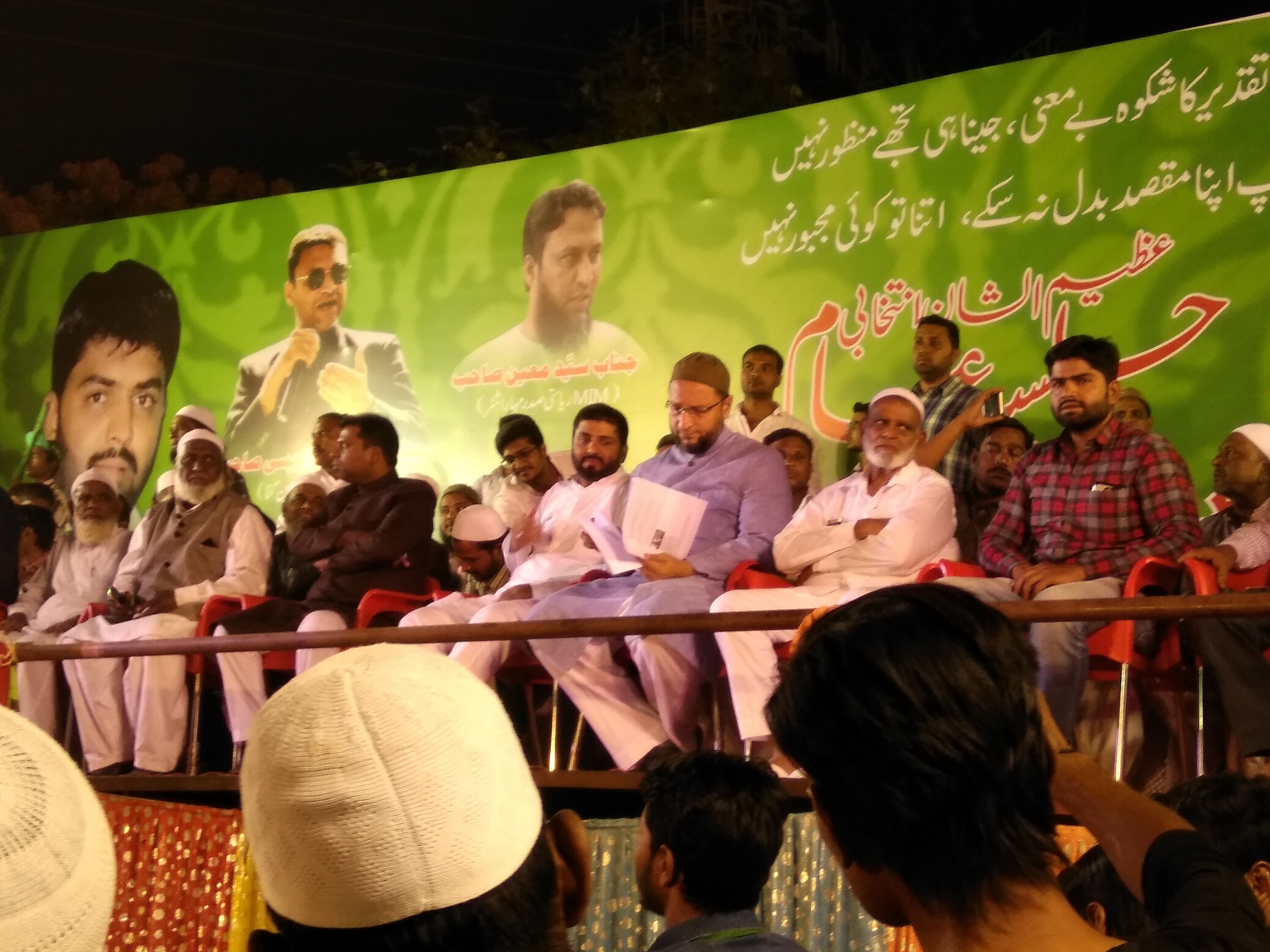
With such living examples of the miscarriage of justice in their midst, and the not-so-distant memory of demonetization and its devastating impact on their economy, it is worth seeing how Malegaon voters are being asked to choose in the Municipal elections later this month. AIMIM has already conducted two public meetings both of which were addressed by star campaigner Asaduddin Owaisi – on the 28th of April and the 3rd of May. In the first one, three days after Pragya Thakur’s release on bail, he made no reference to her or the Malegaon blasts case. Instead, he focused on the love and support his party is receiving now and contrasted it with the difficult years of his personal political journey. “Don’t expect things to be nice and easy, be prepared to struggle for your beliefs,” was the clear message. He also spoke of the need for unity, a very important theme in Malegaon where the ethnic divisions between the Ansari weavers arrived as settlers from U.P, the ones who came from Hyderabad, and the Dakkhani Momin weavers who are from local districts, still produce rival candidates in elections. “If you keep remembering these distinctions of Syed, Ansari, Dakkhani…you will perish,” said Owaisi to an audience that had turned somber and reflective from the tone of his speech.
The foundation of much of what the AIMIM leader touches upon at each of his public meetings had already been laid by the young office bearers of the party in Malegaon. The local chief of the party, Abdul Malik, outlined the 5 big development tasks the party would strive to complete if elected to a good strength in the Corporation. All relate to the most basic infrastructure, but needed to be mentioned as targets. A very good quality primary school with the best facilities for Malegaon’s children, the equipping of two existing government hospitals with the best of medical facilities, 24 hours water supply in every locality of the town, the filth of open gutters to be banished by a good drainage and sewer system, and the improvement of the big, arterial roads in Malegaon. “All these are achievable in our budget of Rs. 425 crores,” said Malik. “We don’t have to wait for State or Central governments to give us any assistance. All we need is your support.” Sharif Thekedar described the Muslim leaders within the Congress and NCP to be totally ineffectual for their community. “When we elect them to the Corporation, they do not even fill up any vacancies that arise in the Corporation with qualified Muslim youth. Unemployment of our educated youth is a big problem for us. All that these politicians have done for so many years is play the politics of fear and take votes from us in the name of secularism.”
The churn taking place in Indian politics today, where parties traditionally seen as secular have failed to provide significant resistance to the majoritarian march of the BJP acquires a much sharper edge in the context of such meetings and messages. A year back, at Malegaon in May 2016, Owaisi had made reference to Pragya Thakur and the case, reminding the audience that in a comparable instance, Rubina Memon was handed out a life sentence for the car in her name being used to carry explosives in the 1993 Mumbai blasts, but Pragya Thakur’s defence was that she had no knowledge of what her bike was being used for in the Malegaon blasts. He had also addressed the issue of young men being radicalized and leaving to join IS (as several had done from Thane), by issuing an open challenge to IS for a debate on Islam. “Do not succumb to these people who do not know the meaning of Islam,” he had declared then.
In the second public meeting on the 3rd of May 2017 for these elections, AIMIM MLAs from Aurangabad and Byculla, Imtiaz Jaleel and Waris Pathan, addressed a huge audience and listed the work they had done in their respective constituencies, reinforcing how it was possible to bring about the change people sought. When Asaduddin Owaisi gave his customary crowning speech, he condemned the U-turn of the NIA in opposing the release of the nine innocent men who had been falsely accused in the 2006 Malegaon blasts case, two years after they had told a MCOCA court that they did not have any evidence linking the men to the blasts. He also spoke once more of unity – this time using an eloquent image from the grape-growing Nashik district to prove his point. “Grapes are most valued when they are in a bunch, when they are together,” he said. “No value is attached to loose and solitary grapes, no matter how sweet they are.” The message to stay together was reiterated once more.
For AIMIM, entering the electoral arena in Malegaon for the first time, winning enough seats to make a difference is vital. For Malegaon’s Muslim voters, resisting radicalization, retaining faith in democratic institutions and exercising their franchise to deliver development is a big challenge. In today’s politically charged times, even municipal elections, whether in Delhi or in Malegaon, have become loaded with significance.