Not For the Faint-Hearted – Documenting Reality

Hansda Sowvendra Shekhar, author of the acclaimed novel ‘The Mysterious Ailment of Rupi Baskey’ (Aleph, 2014) has been entertaining us, his friends on Facebook, with pics of books people read on trains. While these posts make for witty visual statements, they also confirm something I have known this past decade and more – a faithful representation of life-as-it-is-lived will not attract the biggest sales at railway stations. In fact, the situation is likely to be the same at bookstores and other venues as well. Reality doesn’t seem to be in a markedly saleable category.
Hansda’s pics show that a traveller is most likely to be reading a new age retelling of mythology (Meluha, Vayuputra) or a romance peppered with new age insights (Half Girlfriend). These peeps on the move are not interested in reading about other peeps on the move – the kaanwariyas that carry water to Shiva, criss-crossing the country’s landscape in buses, trains, or on foot in the monsoon month of Saawan, or those itinerant toymakers who make and sell their fragile handmade toys at streets and stations, and outside parks, malls and restaurants. Since I am the person who has written about both these categories of people, I feel well and truly marginalized, quite in the manner of my subjects.
In December 2013, at the Taj Literature Festival in Agra, I received my first complete tutorial in the aspirational India that has today become the norm for the media, publishers, politicians, filmmakers and anybody who wants to milk the consumer for a few bucks. It struck me then that if you wanted to be even the tiniest bit successful, you should either be writing content to strike a chord in the aspirational Indian reader, or be so aggressively aspirational in your own demeanour that everybody realized you meant business. So where did that leave a committed writer of narrative non-fiction like me? Strictly in the ‘Go lick your wounds in private’ room.
I may well have found it tough to emerge from that room, if I wasn’t already quite experienced in living around, or in spite of, the severest of limitations imposed by the market, and publishers. I wrote intimately about poverty well before ‘Slumdog Millionnaire’ was made (The Toymakers: Light from India’s Urban Poor, New Horizon Media, 2008). The rejection slips from those days are indelibly seared into my mind. I wrote about Ayodhya, its people, and its lack of development 20 years after the demolition of the Babri Masjid, (Portraits from Ayodhya: Living India’s Contradictions, Tranquebar 2012) when even its perpetrators had moved on to talk of development (in an abstract sense, or as in Gujarat, not Ayodhya). And finally, in a season of celebration of all things Shiva, when his undeniably handsome contours had been sketched in books and on TV, I had written about the indefinable Shiva instead, and his poor, water-bearing followers usually considered a nuisance in urban areas (Bol Bam: Approaches to Shiva, Tranquebar 2013). My timing had always been way off, when measured against the trend of the time, so what the hell? Relative obscurity didn’t matter. I would still write non-fiction, not novels.
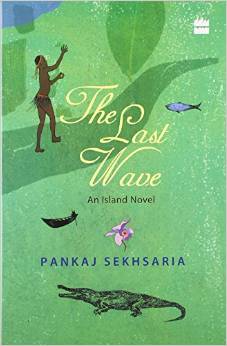
Which is why it felt so good in days just gone by to read Pankaj Sekhsaria‘s book, The Last Wave (Harper Collins, 2014). Set in the Andaman and Nicobar islands, where Pankaj spent many years as a researcher, writer, photographer and campaigner, the novel has several distinct but intermingling tracks through which emerge the history and politics of the island, the lives of its creatures and their environment, the present plight of the Jarawas, the bow-and-arrow wielding original inhabitants of the islands, and the shared destiny of the protagonists of the book. Sekhsaria has managed to do what a documentary film does – provoke us into thinking and understanding conditions as they are in the threatened rainforests of the Andamans. The fact that he has managed to do this through a story is even more rewarding for a reader. The thoughts and feelings of Harish and Seema will find a resonance in the minds of many of us who have grown up and been educated in urban India, conscious of our own helplessness in preventing so much that is happening around us. Sekhsaria brings us the wonder of the Giant Leatherback Turtle nesting on a beach alongside the ugly reality of intrusive foreign crew finding willing collaborators among the locals to showcase the Jarawa tribals for a voyeuristic white audience. In an uncanny resemblance of fact to fiction, a French team has recently been charged with trespassing into Jarawa territory and filming them clandestinely, exactly as it has been portrayed in the book.
I was heartened by Pankaj’s book because it told me that there are those of us who will write about what we want to write, how we want to write it, aspirational model or no aspirational model. So there.