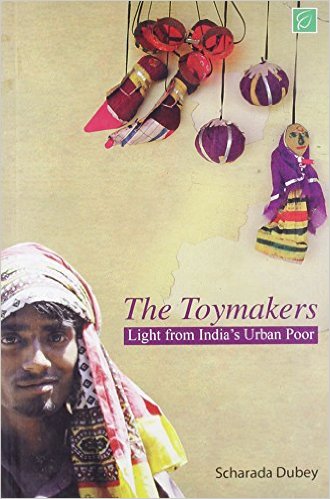
The Toymakers: Light from India’s Urban Poor
Non Fiction
A close look at the courage and creativity of toymakers who are a part of India’s army of street vendors.

Overview
The book which further explores the themes in Scharada’s essay The Bits and Pieces Artists which came second in the Outlook Picador Non-Fiction Contest 2001, this takes readers into the lives of men and women who are crafting objects from paper and cardboard, balloons and string, to bring joy to children. The toymaker is a part of the urban self-employed, who, by asserting himself/herself with their toys, resist being pushed into the category of invisible rural masses, battling disguised unemployment.
The Toymakers was written after meetings and travels with street vendors in 27 towns across India. It portrays, sometimes in stark terms, just how precarious the existence of these ingenious street vendors has become, and makes a case for supporting them with custom, design help and commitment by both, individuals and institutions.

A Glimpse Inside
Chapter 2 - We’re All In It Together
My father came down the Sahyadris
A quilt over this shoulder
He stood at your doorstep
With nothing but his labour
…
It is people like me, builders of
Your grand edifice
Who add to your glory day after day, O City
We live in hell-holes and clean your streets;
Yet like stray hawkers, cops drive us out;
We move on again, settle in another vacant lot;
And live out the legacy of this putrid culture
We toil thus – so many of us
And die exhausted like a burnt-out candle.
( From ‘Mumbai’, a poem by Narayan Surve, translated from Marathi by Mangesh Kulkarni, Jatin Wagle and Abhay Sardesai)
When one thinks of the state of India’s cities, it amazes one to think about the quality of life that still persists. Bad roads, crippling congestion and daunting density. Civic infrastructure that is sketchy enough to spell frequent calamity. Deep pits and heaps of garbage, politicians’ bungalows and acres of slums all shimmering in the sunny haze of a polluted afternoon.
Yet, these are the sites where we live and breathe, spending the finest moments of our lives, as well as the ones most filled with despair. Our cities are in our blood, each one adding spice and salt and flavour to the ordinary haemoglobin.
‘Hai apna Hindustan kahan? Yah basaa hamare ganvon mein’ (Where is our Hindustan? It lives in our villages) wrote Mahatma Gandhi’s biographer and poet Sohanlal Dwivedi in the sixties, and this may still be true, in a sense. But our cities have grown to represent the real face of modern-day India, and the developed democracy we are struggling to be. “More than a quarter of all Indians live in cities, some 250 million people, and it is estimated that by 2010 the figure will exceed 400 million, giving India one of the largest urban populations in the world. In legend and in fact India may still be a land of villages, but no Indian can today avoid the cities,” 2 points out Sunil Khilnani in ‘The Idea of India’.
So who are the figures behind these figures? What do our cities mean to the millions who live in them? To some of us they represent havens for our genius to flourish, for us to snatch some measure of happiness from the fleeting journey called life, tempered by discomforts like the building lift frequently breaking down, traffic snarls on our way to work, or power cuts that nullify the air conditioning. To others who live right next door, they could mean all their belongings in a bundle and a trunk that have to be snatched and fled with every time a slum fire hits. Or daily beatings and wranglings with local policemen for practicing one’s livelihood like driving a cycle rickshaw, vending vegetables or cloth caps, even cutting hair or shaving customers on the side of the road. Its all happening in the city, that great canvas for every comfort and cruelty, where we are both condemned and blessed to be. It is here where we will have to make the choices that will determine what India could and should mean to her people.
A vast network of services manned by people officially working in the ‘informal sector’ of the economy keeps our cities humming with activity and convenient for the urbane. Every city dweller, by his or her mere existence in the town or metro in which he or she lives, is privy to the facilities that this vast informal sector provides. It is due to the presence of such people that one can stand on one’s doorstep or gate, and call out for vegetables, or a person to iron clothes, or a rickshaw to take an elderly relative to hospital. We are everywhere surrounded by the care-givers – those whose job it is to care for us, or so we assume, for a quarter of the price we would pay if the same service was being provided by more recognized agencies. Thus the average person would think nothing of bargaining with a roadside vendor for a leather belt, or haggling with a rickshaw man over the price of a ride. In fact, the ability to drive a hard bargain is often considered a middle-class virtue, especially in these times of inflation.
But what about the service providers? How much of our society’s benefits, its much vaunted drive to development, its gleaming new conveniences are providing any relief to the people who make lives comfortable in the city? In fact, the opposite often happens. The rising influx of people from the rural areas is wont to give city dwellers the chance to complain about how these people are stretching the limited municipal infrastructure to the limit. Many middle-class or affluent conversations could refer to such people as a nuisance comparable to a lower level of life. And many scenes in our metros, such as the crowds of beggars and urchins who descend on cars at traffic signals, would seem to bear out this fact. We cringe and complain and wish the people would just go away – anxious to preserve our sensibilities from the onslaught of pain and ugliness. In our desire for simple relief, we forget that people could hardly be placed in such situations out of their choice. There are powerful forces keeping such people where they are, and the most powerful of them all is our own indifference.
Selected passage from the book