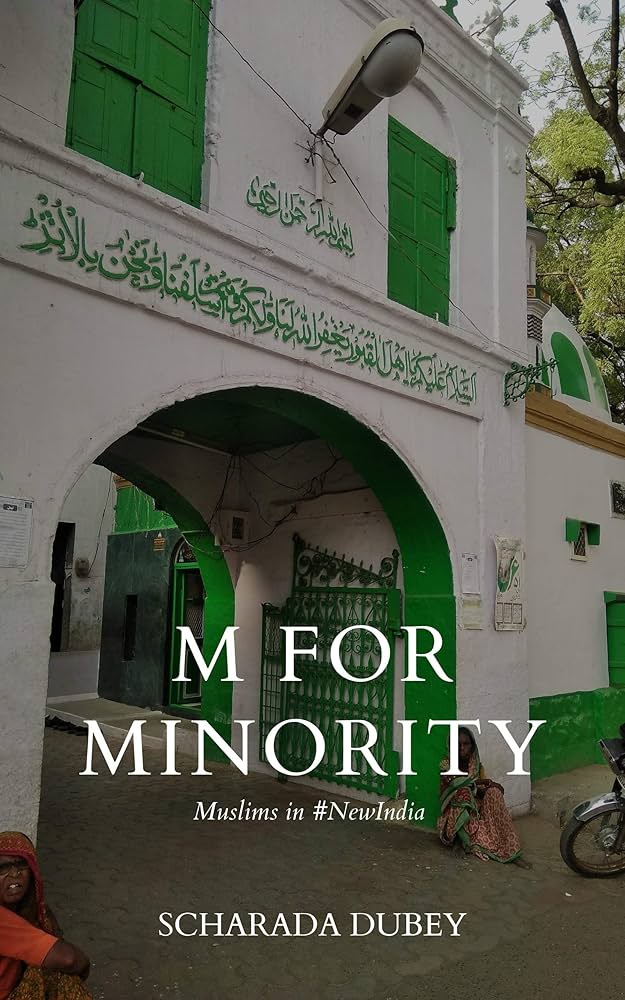
M for Minority: Muslims in #NewIndia
Politics
Written between 2015-2019, this collection of profiles of 25 Muslim personalities reveals their contributions and concerns.

Overview
Dreams, desires, and delivery – Muslim citizens of India share the aspirations of their countrymen. But what they encounter along the path to achieving them is often a disturbing aspect of identity politics. How have some of the most eminent personalities and some ordinary citizens dealt with such challenges? The profiles in this book come from all over the country and range from researchers and historians to poets, professors and those visibly active in the social and political arena. Whether it is the late revered Maulana Kalbe Sadiq, or Asaduddin Owaisi, the rapper Aamir Shaikhspeare or social activist Noorjehan Safia Niaz, each chapter brings fresh insight into our lives and times in #NewIndia.

A Glimpse Inside
Chapter 12: Sarfaraz Ahmed - Intuitive Investigator
Padhaai jaati hai maktab mein ab ghalat taareekh, fasaadi haath mein bachpan hai kya kiya jaaye... Ki sach kuchal diya beva ki hasraton ki tarah, ki jhooth haath mein kangan hai kya kiya jaaye...
-Munir Arman Nasimi
(False history is now taught at school, childhood is in the hands of rioters, what is one to do? The truth has been crushed like a widow's desires, while the liar's hand wears a bracelet, what is one to do?)
The rape and murder of 8 year-old Asifa in Kathua, near Jammu, marked a point of no return for me and I suspect, others, in how we viewed our country and countrymen. Asifa, a child from the nomadic community of Bakerwals, was lured into a temple where she was drugged and imprisoned and repeatedly raped for a week by eight men, including a policeman. She was not given any food. When the decision was taken to finally kill her, one of the men asked to rape her one last time.
Investigation by the Jammu police led to the arrest of the eight men, after which protest marches were taken out in the town, expressing solidarity with the rapists, at which two J&K ministers of the Bharatiya Janata Party were present. In April 2018, after the arrests, when the facts of the case came to light and there were right-wing Hindu groups justifying the protests for the rapists on TV, I felt as if every last drop of morality, humanity had been squeezed out of our people by the prevailing politics of the last decade.
By June 2019, after the Twinkle Sharma rape case of Aligarh, it is clear that we now live in a country where rapes of small girls, even infants are common, and perpetrators are vilified or justified in the media according to their religion. We must daily live with this dreadful awareness until we do something to change it. In April 2018, I reached Solapur just as the outrage against the Asifa rape was building up across India.
Sarfaraz Ahmed, the researcher and history activist I had come to meet, was busy organizing a citizens protest against the Asifa rape and murder, two days after my arrival. "We will be having a sit-in protest. A mute demonstration, no speeches, no political statements. Five small girls will sit at the front of our protest. At the end of the hour, we will hand over a letter signed by all of us to the district administration demanding justice in this case and the protection of women and children in our society. We want the numbers of people to be significant, not make an aggressive or loud demonstration" he told me.
"Absolutely," I said, agreeing. "Aggression and loudness have become a national disease."
Over lunch, I talked to him about the books he had written and the Advocate Ghaziuddin Research Centre with which he is closely associated. I had last met Sarfaraz in September 2017, when he had launched a book he had written on Hyder Ali and Tipu Sultan. We caught up on the main focus of his work - the correction of historical omissions and falsehoods.
"We are committed to bringing out 20 books every year till 2025, at the Advocate Ghaziuddin Research Centre" he said. "This has become an absolute necessity because the Modi government, has unleashed a planned conspiracy, unknown to all, which goes under the title 'Mission for Manuscripts'. Under this, letters have been sent to all State governments, asking that whatever private and publicly owned historical manuscripts they have in their States should be sent to the Central government for the creation of a centralized database' said Sarfaraz.
"It could be a laudable effort if done with integrity, but not if it is being done by the Modi government, backed by the Sangh" he continued. "What could be their ultimate goal? Not the scientific preservation of manuscripts, presumably, since their politics is entirely based on the distortion of history" I wondered aloud. "How have they begun the process?"
"They have put together a team of their handpicked people. What they will do is, authoritative texts which are already in the public domain, like Bhimsen Saxena's Taarekh-e-Dilkusha, they will not touch. But those manuscripts that no one knows or has written about - like 17 such manuscripts on Quli Qutub Shah found in Andhra, for instance, they will destroy all trace of those. Not a single book has been written on him. Quli Qutub Shah will cease to exist. He was succeeded by Mohammed Qutub Shah, Ali Qutub Shah. Who will know?" asked Sarfaraz.
"Further gaps being created that can be filled in with something else" I said, and he nodded.
"Who knows about the governance of Adil Shah? The vaastu shastra of the Taj Mahal? All these documents are lying in the Bangalore Archives. All these can be destroyed. So we have prepared a plan to counter this by collecting all the manuscripts relating to Muslim rulers in south India and preparing copies of them, perhaps digitize them also at a later date, so that we are not left stranded should these be destroyed."
Selected passage from the book