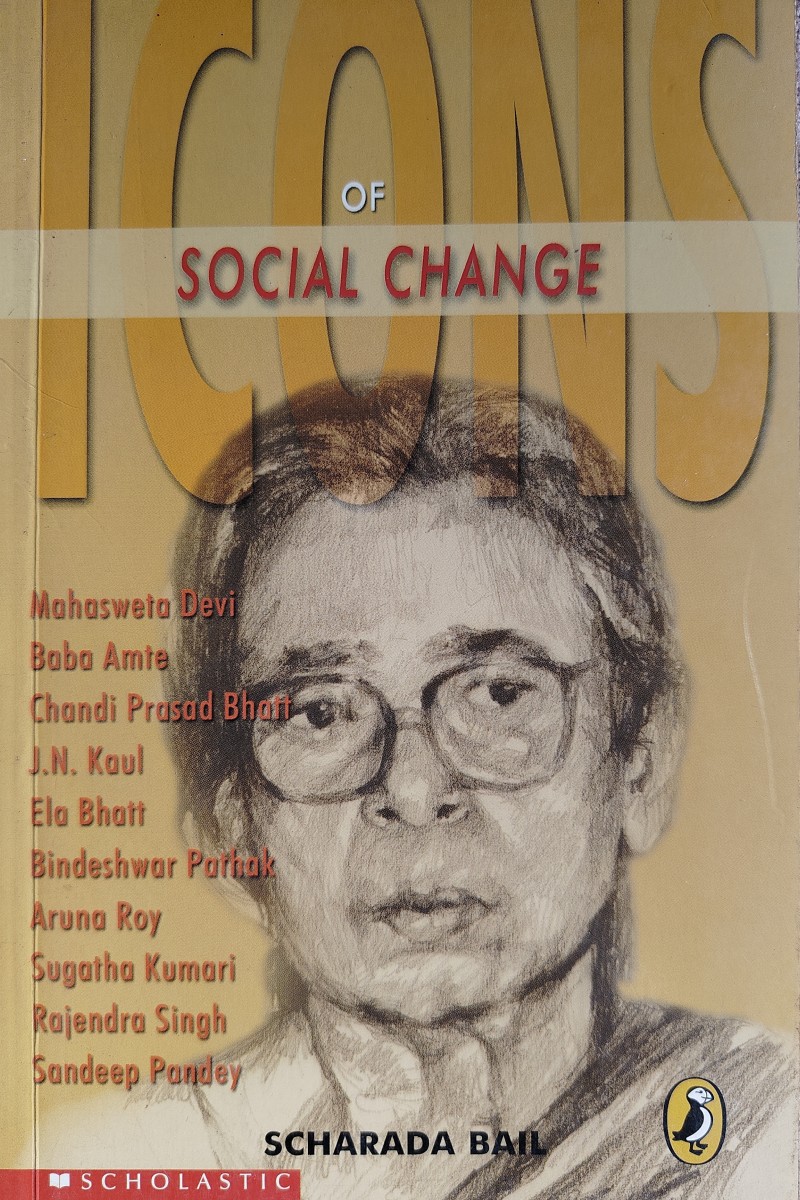
Icons of Social Change
Politics
Inspirational profiles of ten Indians who empowered their fellow citizens in different ways.

Overview
A refusal to accept injustice is a common thread that binds together these ten personalities that brought transformation for thousands of people. From Mahasweta Devi whose pen brought to light the living conditions of tribals, Baba Amte, who fought against the stigma around leprosy, to Bindeswar Pathak who fought for every citizen’s right to hygiene and cleanliness and set up public toilets, and Rajendra Singh, who brought water back into the wells and rivers of western Rajasthan, these are mean and women who can point the way forward for meaningful change to young readers.

A Glimpse Inside
Knowledge as Power
The April sun was already very warm on the heads of the hundreds of villagers assembled in the Gomti Churaha centre of Beawar town in Rajasthan. Tents erected around the area were meant to shelter the villagers in the nights for the duration of their stay. Thirty-seven of these were already filled, and people still continued to pour in to the town from the 300 and more villages in the area.
In the colourful and picturesque state of Rajasthan, where tourists jostle each other to take pictures of the turbans and moustaches of men, and the multi-hued ghagras and chunris of women, a passer by could have been forgiven for thinking this was another of those village fairs.
But if he or she leaned closer to the groups talking animatedly among themselves, he or she would have noticed some important differences. Firstly, women and men talked together in a way different from the usual gender based segregation in villages. Secondly, their conversation revealed far more serious concerns than the sale of camels, or a village feud.
“For just 10 villages, between 1994 and 2000, the amount they have managed to divert from actual use is Rs. 45 lakhs!” said one villager. “And that is from only 31 projects studied from the 98 they had announced,” said another voice, this time a woman’s. “If the tally is Rs. 45 lakhs diverted from 1 crore even without half the projects being examined, then just calculate what will be the final score!” said another villager excitedly.
In response to this, the assembled group raised a slogan, “Roti do, naukri do, nahin to gaddi chod do!” (Give us bread, and give us jobs! If not, get out of that seat of power!) Clearly, this was no routine celebration marking the passing of any season in festive Rajasthan. It was a Jan Sunwai, or public hearing, called by the Mazdoor Kisan Shakti Sangathan (MKSS). In April 2001, the villagers around Beawar had assembled to mark five years of their movement for the Right to Information.
In another thickly packed group of villagers in animated discussion, a slightly built, saree-clad woman sat listening attentively to what the villagers were saying. “Now that the official records are in our hands, we have a very powerful case for the corrupt officials’ arrest,” she said in a quiet voice, when the group had turned to her for guidance at one point. The assembled group responded with exclamations, grunts, and approving murmurs. The villagers’ may have still doubted the official machinery that would have to move to arrest the corrupt officials that had robbed public money marked for development. But they had no doubt at all about the ability or determination of MKSS leader Aruna Roy. A woman who had traveled a long way to get here.
Official budgets, that earmark money meant to be spent for the public good, are a routine feature of our lives. They are announced daily through our newspapers, television reports, and even on posters and hoardings in big cities, put up in praise of one or another leader.
If we listened closely to these announcements, and kept a tally of how much money has been supposedly spent in improving roads, sanitation, public health and education, we would indeed wonder why India is still a ‘developing’ country. Why do large sections of Indian people have to live in such abject poverty, when every passing day brings some official scheme or project to improve their lives? The official figures of expenditure, and the reality we see before our eyes everyday, present a completely contrasting picture.
We hear only too often, about the ‘corruption’ that goes on around us. But what form does this corruption take, and how does it harm us? And more importantly, how can we, and fellow citizens, put an end to corrupt practices?
Selected passage from the book